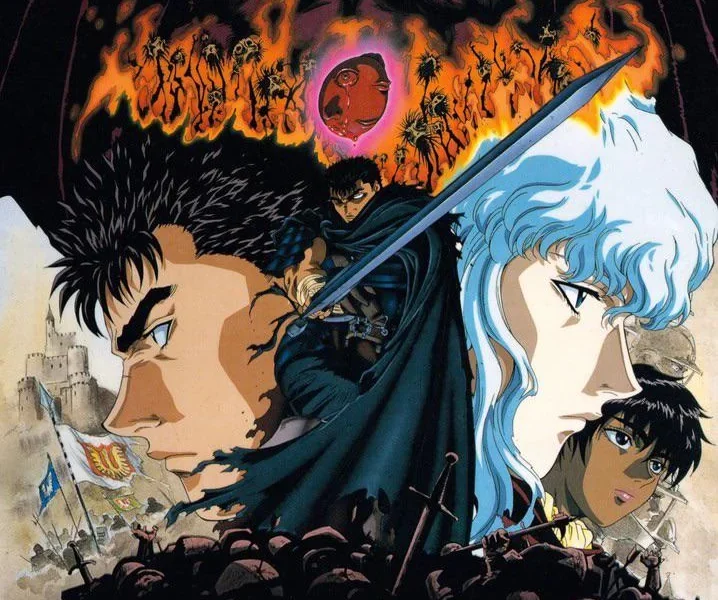
Berserk (1997)
Ambition, Betrayal & the Price of a Dream

Some stories ask what you’re willing to sacrifice for your dreams. Berserk asks what happens when you decide other people’s lives are worth sacrificing.
The Story
Guts is a mercenary who has spent much of his life surviving one battle after another. His path changes when he encounters Griffith, the charismatic leader of the Band of the Hawk.
Under Griffith’s leadership, the group rises through the ranks of Midland’s military. Along the way, Guts develops meaningful relationships and begins questioning what he actually wants from his own life.
What begins as a medieval war story gradually becomes an exploration of ambition, loyalty, friendship, and the darker side of human nature.
My Thoughts
There’s a reason people are still debating Berserk decades after its original release. It’s not simply because of the violence, the battles, or the shocking ending. It’s because the characters are complicated.
Griffith is fascinating because his ambition is both admirable and terrifying. He’s intelligent, charismatic, and capable of inspiring extraordinary loyalty. But how much of that loyalty is genuine friendship, and how much is built around his personal ambitions?
Guts is almost his opposite. He begins as someone who knows how to survive but struggles to understand what he’s actually living for.
Watching him gradually form connections with others gives the story its emotional weight.
And Casca deserves recognition too. Her loyalty, personal struggles, and relationships with both men make her essential to the story rather than simply a supporting character.
Guts and Griffith: Freedom and Ambition
One of the most interesting philosophical conflicts in Berserk is the difference between Guts and Griffith.
Griffith knows exactly what he wants. His dream gives him purpose, but it also becomes something that controls him.
Guts, meanwhile, spends much of the series trying to discover his own purpose. He wants to become someone who can stand beside Griffith as an equal rather than simply exist within Griffith’s dream.
This creates a fascinating contradiction. Griffith appears to be the man with complete control over his destiny, yet he becomes increasingly dependent on achieving one particular goal.
Guts appears to have far less control over his circumstances, but his decision to search for his own path becomes an expression of genuine freedom.
And that’s where the story asks something uncomfortable: when does ambition stop being a source of motivation and start becoming an obsession?
Atmosphere and Soundtrack
The 1997 adaptation has a distinct atmosphere that makes it memorable even today.
Its medieval environments, muted colors, and dramatic character designs establish a world that feels harsh and unforgiving.
The animation can be limited, particularly during some action sequences, where still images and repeated shots are noticeable.
But the direction often compensates through framing, expressions, and tension.
Susumu Hirasawa’s soundtrack is another major highlight. The music can feel strangely peaceful and haunting, especially when contrasted with the violence and tragedy of the story.
For me, the atmosphere is one of the biggest reasons this adaptation still stands out.
The Viewing Experience
These percentages reflect my personal viewing experience rather than objective measurements.
Spoiler Warning
The following sections discuss the Eclipse, Griffith’s transformation, and the ending of the 1997 anime.
If you haven’t finished all 25 episodes, consider returning after watching.
The Eclipse: Fate or Choice?
The Eclipse is one of the most disturbing moments in Berserk, not simply because of the horrific events that unfold, but because of the betrayal behind them.
After Griffith loses almost everything, the God Hand offers him an opportunity to pursue his dream once again.
The price is the sacrifice of the Band of the Hawk.
These are the people who fought beside him, trusted him, and helped bring him closer to the future he imagined.
And Griffith accepts the sacrifice, leading to his transformation into Femto.
What makes this so interesting philosophically is the question of fate versus responsibility.
The God Hand presents events as part of a larger predetermined path. But if Griffith was destined to reach this moment, does that make his decision any less his own?
I don’t think understanding his desperation automatically makes his actions forgivable. Being able to explain someone’s behavior is very different from justifying it.
An Ending Without Resolution
And then there’s the ending.
After spending 25 episodes developing the relationships within the Band of the Hawk, the anime leaves viewers during the catastrophic events of the Eclipse.
Griffith has become Femto. The Band of the Hawk has been sacrificed. Guts and Casca are trapped in a nightmare, and the anime ends without showing their immediate rescue.
It’s an incredibly abrupt conclusion, particularly for anyone experiencing Berserk for the first time.
The original manga continues beyond these events and provides important missing context, including the intervention of Skull Knight.
While the cliffhanger makes the ending unforgettable, it’s also one of my biggest frustrations with this adaptation.
I appreciate an ending that leaves people thinking, but there’s a difference between meaningful ambiguity and stopping before a major conflict is resolved.
Still, it’s hard to deny the impact. Decades later, people are still discussing why the anime ended this way.
The Question of Griffith
This is the question I find most interesting.
Was Griffith always capable of sacrificing the people closest to him? Or did the circumstances surrounding his downfall fundamentally change him?
I think the story gives viewers enough complexity to understand why this debate continues.
Griffith isn’t written as someone without emotions or attachments. His relationship with Guts clearly affects him.
But genuine attachment doesn’t necessarily mean someone is capable of respecting another person’s independence.
That’s why Guts leaving the Band of the Hawk is such an important turning point.
Griffith can command armies and influence powerful people, yet he struggles to accept that someone important to him might choose a different path.
And perhaps that’s the tragedy. Griffith wants to control his destiny, but cannot accept that other people have destinies of their own.
What Worked
- Complex relationships between the main characters
- Strong psychological and philosophical themes
- Memorable atmosphere and soundtrack
- Excellent buildup throughout the Golden Age arc
- A conclusion that leaves a lasting impression
What Fell Short
- Some noticeably limited animation
- Important manga material is omitted
- The final episode ends extremely abruptly
- New viewers may feel confused about what happens next
- The adaptation leaves major storylines unresolved
Content and Audience
Berserk is intended for mature audiences. It contains graphic violence, sexual violence, disturbing imagery, abuse, trauma, and intense psychological themes.
I recommend checking detailed content warnings before watching, especially if you’re sensitive to these subjects.
This anime is best suited to viewers interested in mature dark fantasy, morally complicated characters, and stories that explore human nature beyond simple good-versus-evil conflicts.
Beyond the Anime
The 1997 anime only adapts part of the original story.
If the ending left you wondering what happens next, the manga is the best place to explore the larger narrative.
Original Manga: Explore Berserk at Dark Horse Comics
Physical Anime Release: View the Berserk Blu-ray listing
Availability and editions may vary. The linked Blu-ray listing is provided as a shopping reference.
If you’re continuing with the manga, consider reading from the beginning to experience the original story, including material not covered by the television adaptation.
The Discussion
I want to hear what other Berserk fans think about Griffith.
Was he always capable of betraying the Band of the Hawk, or did his circumstances push him toward that decision?
And does understanding someone’s motivations make their actions any more forgivable?
Also, let’s talk about the ending. Did the 1997 cliffhanger make the anime more memorable, or did it leave too much unresolved?